
Chicago City Council Q1 2026 Report Card
How this was made
Two meetings. 1,321 agenda items. Eight contested votes that actually split the chamber. That's what the first quarter of 2026 looked like at Chicago City Hall — and the data tells a clearer story than the official minutes ever will.
The Chicago City Council convened twice in Q1 2026: January 21 and February 18. Using the public meeting record, we scored every alderperson across three dimensions — attendance, participation, and contribution — to produce the first Quiet Commons aldermanic report card of the year.
How the Scoring Works
The score is out of 100 points, split across three categories:
Attendance (40 points): Were you in the chamber when the city's business was being conducted? Simple. One point per percent of meetings attended.
Participation (40 points): Did you vote on the contested items that actually mattered? Absences, "Not Voting" marks, and recusals on key roll calls cost points here.
Contribution (20 points): Did you exercise independent judgment? Alderpersons who voted Nay or Present (rather than reflexively Yea) on contested legislation score higher here. A council that votes unanimously on everything isn't deliberating — it's rubber-stamping.
This methodology has limits — we can't measure constituent services, committee work, or floor speeches from this data alone. But it gives you a clean, objective baseline for how your alderperson shows up when the chamber is in session.
The Meetings at a Glance
The January 21 session had perfect attendance: all 50 alderpersons present. It was a dense agenda — 614 items, including two controversial roll calls that split the chamber along ideological lines. The February 18 session ran even longer, with 707 agenda items and five contested votes, though one alderperson was absent for the entirety.
January 21, 2026 — 50/50 present · 614 agenda items · 3 contested votes
February 18, 2026 — 49/50 present · 707 agenda items · 5 contested votes
Combined, the council processed 1,321 agenda items across two sittings, with 8 contested roll calls where members broke from the majority. The vast majority of that business — zoning reclassifications, sign permits, honorary street designations, small claims payments — is purely routine. The eight contested votes are where the real story is.
The Contested Votes That Defined Q1
Most of the council's business is unanimous. The contested votes are the exception — and the most revealing signal of where alderpersons actually stand.
Hemp Products Regulation (SO2025-0021018) — Jan 21
The biggest split of the quarter. This ordinance amended the Municipal Code to regulate cannabinoid hemp products, including definitions, health requirements, and offenses involving minors. It passed, but not easily: 16 alderpersons voted Nay, 2 voted Not Voting, and 1 (Ald. Dowell, Ward 3) was recused. Among the Nay votes: Dowell (W3, recused), Robinson (W4), Yancy (W5), Ramirez (W12), Fuentes (W26), Clay (W46), Manaa-Hoppenworth (W48), Taylor (W20), Moore (W17), Sigcho-Lopez (W25), Rodriguez (W22), Hadden (W49), Taliaferro (W29), La Spata (W1), Rodriguez Sanchez (W33), and Quezada (W35). Hall (W6) and Conway (W34) voted Not Voting.
Police Settlement — Tim Anderson et al. (Or2026-0022295) — Jan 21
The second major flashpoint. This settlement agreement stemmed from a civil rights lawsuit (Case No. 2023 L 010164) against the city and individual officers. It passed, but drew 15 Nay votes, including from Alderpersons Lopez (W15), Reilly (W42), Chico (W10), O'Shea (W19), Tabares (W23), Beale (W9), Napolitano (W41), Gardiner (W45), Cardona (W31), Silverstein (W50), Villegas (W36), Hopkins (W2), Quinn (W13), Curtis (W18), Waguespack (W32), and Scott (W24). Coleman (W16) and Rodriguez Sanchez (W33) voted Not Voting, and Dowell (W3) was recused.
Settlement — Nicolas Sintos (Or2026-0022294) — Jan 21
A smaller split on a separate settlement agreement. Only Taylor (W20) and Moore (W17) voted Nay, with all others voting Yea. Small in number, but notable as two progressive alderpersons choosing to diverge from the mayor's position on a police-related matter.
Cortland Street Zoning (SO2025-0020885) — Feb 18
A special use and zoning reclassification on Cortland Street that passed overwhelmingly — with one exception: Ald. Brian Hopkins (Ward 2) voted Nay. Hopkins represents Streeterville, River North, and the Near North Side — a ward that has seen sustained pressure from residential development interests. Without floor debate recorded in the ingested data, it's not possible to say definitively why Hopkins broke from the chamber, but Ward 2 zoning votes often reflect constituent-level negotiations over density and building character that don't make the headlines.
Gas Station Zoning (SO2025-0018183) — Feb 18
A zoning amendment related to a gas station use that passed with one dissent: Ald. Raymond A. Lopez (Ward 15) voted Nay. Lopez represents Brighton Park and Gage Park on the Southwest Side — a ward with a mix of residential streets and commercial corridors. A Nay on a gas station special use in a neighboring ward typically signals either a broader land-use philosophy or a more specific objection to the project's traffic, environmental, or compatibility implications.
Places of Worship Noise Ordinance (O2026-0022493) — Feb 18
An ordinance adjusting noise zone regulations for places of worship that passed with one dissent: Ald. David H. Moore (Ward 17) voted Nay. Moore represents Kenwood and Woodlawn on the South Side. This is the second time Moore cast a standalone dissenting vote in Q1 — he was also one of just two alderpersons to vote Nay on the Sintos settlement in January. Whether this reflects a principled pattern of independence or ward-specific constituent concerns, Moore is emerging as one of the chamber's more active dissenters this quarter.
Police Settlement — Rogel / Flores Gomez (Or2026-0023423) — Feb 18
This is the most unusual result of the quarter. A police-related settlement — the kind of item that typically passes quietly on a near-unanimous roll call — failed to pass on February 18. The reason is procedural: virtually the entire chamber voted Not Voting, effectively blocking the measure without casting a formal Nay. That's a coordinated move, not an accident. What it signals — a dispute over the settlement amount, a political message to the administration, or a procedural maneuver to send the item back to committee — isn't captured in the vote record alone. But when 48 alderpersons simultaneously decline to vote on a settlement, that's not a clerical quirk. Something happened, and it happened on purpose.
Resident Parking Enforcement Pilot (SO2024-0010993) — Feb 18
The most consequential and revealing vote of the entire quarter. This substitute ordinance, sponsored by Ald. Daniel La Spata (Ward 1) and championed through his Committee on Pedestrian and Traffic Safety, would have established a two-year pilot program allowing residents to submit cellphone photos and video of commercial vehicles blocking bus lanes, bike lanes, and crosswalks via the city's 311 system. A 311 agent would then be dispatched to ticket the driver.
It failed to pass — killed on the floor 22 Nay to 15 Yea, with 2 Not Voting. The Yea side was a fairly predictable coalition of progressive and transit-oriented wards: La Spata (W1), Manaa-Hoppenworth (W48), Vasquez (W40), Martin (W47), Sigcho-Lopez (W25), Fuentes (W26), Cruz (W22), Gutierrez (W14), Ramirez (W12), and several Near North and lakefront alderpersons. The Nay majority was broader, cutting across the South Side, Southwest Side, and Northwest Side.
Why the Parking Vote Went the Way It Did
On paper, this ordinance is extremely easy to support. It costs the city nothing. It targets commercial vehicles — delivery trucks, not residents' cars. It focuses specifically on lanes and zones that already exist. The committee hearing on February 9 was standing-room only, and the safety case is viscerally compelling: a three-year-old named Lily Shambrook was fatally struck in 2024 after a trucker illegally parked in a bike lane, forcing a cyclist into traffic. La Spata invoked that case directly. The committee passed it 9-1.
Then 22 alderpersons voted it down on the floor two weeks later. Here's why that probably happened — and this is speculative, because floor debate isn't captured in the vote record:
The "Neighbor Surveillance" Objection
Business improvement groups and the Illinois Trucking Association lobbied hard against this ordinance at committee. Their argument: a citizen-enforcement model creates an unaccountable system where anyone with a phone can generate fines against commercial drivers, potentially based on incomplete information or personal vendettas. Alderpersons who represent wards with significant commercial corridors — loading zones, restaurant rows, industrial edges — are more likely to hear from local business owners who fear ticket harassment than from cyclists who use bike lanes. On the Southwest and South Sides, where bike infrastructure is sparser and commercial delivery is a lifeline for small businesses, that constituency calculus flips.
Car-Dependent Wards vs. Transit-Dependent Wards
Look at the Yea coalition geographically: it's almost entirely the lakefront, the near Northwest Side (Logan Square, Bucktown, Wicker Park), and the near Southwest Side (Pilsen, Bridgeport). These are the wards with the most bike infrastructure, the highest bike ridership, and the most constituents who actually encounter blocked lanes regularly. They're also among the most transit-dense parts of the city.
The Nay majority is largely the outer ring — wards where car ownership is higher, bike lanes are sparse or nonexistent, and the 311 system is already stretched. For an alderperson representing the far South Side or the Northwest Side bungalow belt, blocked bike lanes are not a top-ten constituent complaint. Empowering residents to generate parking fines against commercial trucks might look less like a safety measure and more like a downtown solution being imposed on neighborhoods that didn't ask for it.
The "Small Business" Shield
Several Nay-voting wards contain dense clusters of small restaurants, retailers, and service businesses that depend on double-parked delivery trucks. The ordinance specifically targeted commercial vehicles — but "commercial vehicle" covers the produce truck making morning runs to a corner restaurant just as much as it covers an Amazon delivery van. Alderpersons on wards like the 19th (O'Shea, Beverly/Morgan Park) or the 23rd (Tabares, Garfield Ridge/Clearing) may calculate that their constituents value delivery access to neighborhood businesses more than they value protected bike lanes they're not using.
The Aldermanic Privilege Factor
There's also a structural reason to be skeptical of any enforcement mechanism that operates citywide without aldermanic input. Chicago's long tradition of aldermanic prerogative — the de facto veto alderpersons hold over infrastructure and enforcement in their wards — makes some members instinctively resistant to systems that can generate fines in their ward based on a 311 report they didn't review. A citywide pilot with no ward-level opt-out is, in that framework, a threat to local control. The irony is that the ordinance was specifically designed to address the gap left by that same aldermanic prerogative: CDOT won't install enforcement cameras without aldermanic sign-off, and many alderpersons won't sign off. Resident video was the workaround. The council voted down the workaround.
What Hopkins Said
One data point worth noting: Ald. Brian Hopkins (Ward 2), who voted Nay on the Cortland zoning item at the same February 18 session, was quoted at committee as supporting the parking enforcement pilot — noting that bike lanes on Wells Street in his ward see heavy use but are constantly blocked by delivery trucks. "We know the delivery companies most likely to be blocking a bike lane," he said. If Hopkins ultimately voted Yea on the parking ordinance (the committee dynamics suggested he would), then the Nay majority was built almost entirely from wards where active bike infrastructure is minimal and constituent demand for enforcement is low. That's not a policy argument about safety. That's geography.
The Scores
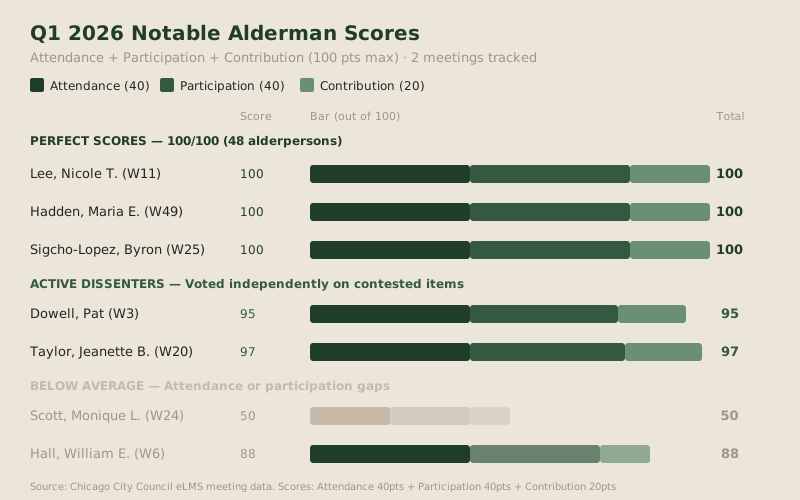
Q1 2026 alderman scores broken down by category. Perfect attendance yields 40 points; full participation on contested votes yields 40; exercising independent judgment on those votes yields up to 20.
The 100-Pointers (48 Alderpersons)
The vast majority of the council — 48 of 50 alderpersons — attended both meetings and cast votes on every contested roll call. In a 50-member body with only two meetings and eight contested votes in the quarter, full marks are achievable, and most members hit them. A score of 100 doesn't mean they were all active, engaged legislators — it means they cleared the floor-presence bar that this data can measure.
Notable full-scorers who also voted independently on contested items (earning them maximum contribution points) include:
Ald. Jeanette B. Taylor (Ward 20) — Nay on the Sintos settlement
Ald. David H. Moore (Ward 17) — Nay on the Sintos settlement; Nay on the Feb 18 places of worship ordinance. Two solo dissents in one quarter.
Ald. Maria E. Hadden (Ward 49) — Nay on hemp regulation
Ald. Daniel La Spata (Ward 1) — Nay on hemp regulation; sponsor and Yea vote on the defeated parking enforcement pilot
Ald. Byron Sigcho-Lopez (Ward 25) — Nay on hemp regulation
Ald. Rossana Rodriguez Sanchez (Ward 33) — Nay on hemp regulation; Not Voting on the Anderson settlement
Notable Deductions
Ald. Monique L. Scott (Ward 24) — estimated 50/100. The only alderperson absent for the entirety of the February 18 session, Scott missed 707 agenda items and five contested votes in a single day. The city's own meeting records show her absent from all roll calls that session. Over the full Q1 period tracked by the council's metrics system, she attended just 1 of 4 tracked sessions — a 25% attendance rate. That's the lowest in the chamber by a significant margin, and it's the defining data point of Q1.
Ald. William E. Hall (Ward 6) — estimated 88/100. Present at both meetings, but voted "Not Voting" on the hemp regulation ordinance — one of only two alderpersons to do so. "Not Voting" is a procedural choice that avoids taking a position, which costs participation points here.
Ald. William Conway (Ward 34) — estimated 88/100. Same situation as Hall — present both sessions, but chose Not Voting on the hemp ordinance rather than casting a yes or no.
Ald. Stephanie D. Coleman (Ward 16) — estimated 92/100. Present for both meetings but voted Not Voting on the Anderson police settlement.
Ald. Pat Dowell (Ward 3) — Special Case
Dowell voted Nay on hemp regulation and was formally recused from the Anderson settlement — a different procedural status than "Not Voting." Recusals typically indicate a conflict of interest and are the appropriate move when one exists. We don't penalize recusals the same way we penalize "Not Voting," which is often a choice to avoid a politically difficult position. Dowell's estimated score: ~92/100.
What Passed This Quarter
Beyond the contested votes, the council's Q1 workload covered a wide range of substantive legislation:
ADU expansion (SO2026-0022453): The council amended the Municipal Code to expand where additional dwelling units are allowed in RS-zoned areas — a win for housing density advocates that passed unanimously on Feb 18.
Parking minimums near transit (SO2025-0021721): New construction near CTA and Metra stations will no longer be required to hit minimum parking ratios. Passed unanimously — a significant urban planning shift.
Historic landmark designations: The Original Providence Baptist Church at 515 N Pine Ave received landmark status, as did the Humboldt and Sacramento Boulevard Extension District. Both passed without opposition.
Cannabis/hemp regulation: The hemp ordinance (SO2025-0021018) created a regulatory framework for cannabinoid hemp products in the city, including restrictions on sales to minors. It passed despite significant opposition.
Public library board appointments: Jacquelyn Rosa and John Dale (J.D.) Van Slyke were confirmed to the Chicago Public Library Board — unanimously.
Annual appropriations amendments: Several mid-year budget modifications passed, including amendments for the Chicago Department of Public Health and fund reallocation across Housing, Cultural Affairs, Police, OEM, and Fire.
ChiBlockBuilder sales: Multiple city-owned properties were sold to community development organizations and private developers under the ChiBlockBuilder program, spread across South Side and West Side wards.
Police settlement — Tim Anderson et al.: A significant civil rights settlement passed over substantial opposition from alderpersons who represent more conservative wards.
What to Watch in Q2
The March 31 meeting data won't be ingested until the next reporting cycle, so Q1 officially covers the two sessions analyzed here. But a few threads are worth tracking as Q2 begins:
Ald. Scott's attendance trajectory. A 25% attendance rate over the first three months is significant. Whether it's a pattern or a temporary circumstance will be clearer by June.
Hemp regulation implementation. The ordinance that drew the quarter's biggest dissent is now law. Watch for any challenges or clarifying amendments.
ADU and parking minimum rollouts. Two zoning changes with real neighborhood implications. Expect ward-level pressure on both as developers start filing permits.
The parking enforcement pilot — take two? La Spata's ordinance is dead for now, but the geography of the vote is a roadmap for what a revised version would need to address. A ward opt-in model, or a narrower pilot scoped to specific corridors, might peel off enough Nay votes to pass. Watch whether the sponsor reintroduces.
The Rogel/Flores Gomez settlement. A police settlement that the entire chamber declined to vote on doesn't just disappear. It will come back, and when it does, the chamber's willingness to actually vote will be worth watching.
Police settlements. The Anderson settlement passed, but the vote revealed a clear ideological divide between alderpersons who represent neighborhoods skeptical of the city's police accountability record and those who prefer to avoid public confrontations with the administration.
We'll update the scorecard each quarter as new meeting data is ingested. If your alderperson isn't showing up — for any reason — that's information your ward deserves to have.