
The Parking Meter Deal Is Changing Hands. Can Chicago Use That to Get Out?
How this was made
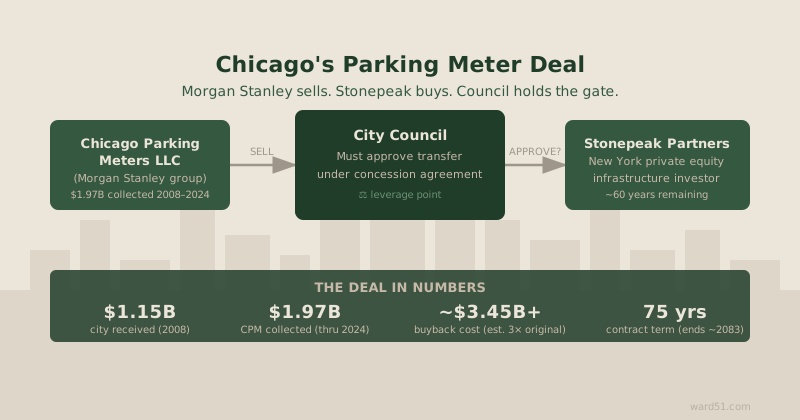
The transfer of Chicago's 75-year parking meter lease now sits before City Council — the city's only real leverage point.
A Morgan Stanley-led investment group is selling Chicago's parking meters to a New York firm called Stonepeak Partners. The 75-year lease — the one Mayor Richard M. Daley signed in a lame-duck session in December 2008 for $1.15 billion, which analysts later called the worst municipal deal of the century — is changing hands. And for the first time in nearly 18 years, the city of Chicago sits at a table with something resembling leverage.
The concession agreement requires City Council to approve any transfer of ownership. The aldermen haven't voted yet. That means, for a brief window, the people of Chicago have a seat at a negotiation they were never invited to in the first place.
So: can the city use that moment to actually get out? Can it sue its way to freedom while the contract is mid-transfer? Or is this just another chance to watch money flow into private hands while the city shrugs?
Let's look at the tape.
What the Deal Actually Is (The Short Version)
In 2008, Daley's administration sold a 75-year lease on Chicago's roughly 36,000 parking meters to Chicago Parking Meters LLC (CPM) — a consortium led by Morgan Stanley Infrastructure Partners — for $1.156 billion. The city burned through most of that money within a few years plugging budget holes. The meters, meanwhile, started printing money for CPM at a rate the city never anticipated.
By 2024, an independent audit revealed CPM had collected $1.97 billion from the meters — and still had approximately 60 years left on the contract. The investors had recouped their entire initial investment plus an additional $500 million by 2023 alone. The contract runs to roughly 2083. Most of us reading this will not live to see it expire.
The terms of the deal made it nearly impossible to undo. Under the concession agreement, if the city takes actions that reduce the value of the metered parking system by 25% or more, CPM can terminate the agreement and demand compensation for the rest of its projected 75-year profitability. Every bike lane, bus rapid transit corridor, street festival, and pandemic-era closure triggered a potential compensation claim. The city has been paying for it ever since.
Most recently: in May 2025, Chicago settled three CPM claims — stemming largely from pandemic-era decisions made under former Mayor Lori Lightfoot — for $15.5 million in cash plus $7.2 million in legal fees. CPM had originally demanded $322 million. The city got to keep $26.2 million in parking revenue it had clawed back during the dispute, making the net math roughly a wash — which the Sun-Times accurately characterized as "a comparative victory" given what had been at stake. In an earlier round, Morgan Stanley had already won a $61 million judgment against the city over street closure penalties.
Who's Buying and Why It Matters
Stonepeak Partners is a New York-based infrastructure-focused private equity firm. If you haven't heard of them, that's by design — private equity generally prefers not to be in the newspaper. They submitted the winning bid through a process run by Evercore, CPM's financial advisor, and Mayor Brandon Johnson's office confirmed the tentative deal on May 18, 2026.
The financial terms of the Stonepeak purchase were not disclosed. What we do know: Johnson explored a city buyback earlier this year and walked away after learning the asking price was at least triple the original $1.15 billion — meaning somewhere north of $3.45 billion. The city, facing its own structural budget pressures, couldn't get there. Stonepeak apparently could.
The sale now sits before City Council. The ordinance was introduced on May 20, 2026. Aldermen have not yet voted. Under the terms of the concession agreement, the transfer requires city approval — and critically, the Chicago Tribune's editorial board noted last week that approval authority here rests with the Council, not the mayor. Johnson doesn't have a veto on this one. The aldermen hold the pen.
The Legal Question: Can the City Sue Its Way Out?
This is what people are asking, and it's worth being precise about what has already been tried.
The honest answer is: probably not, and the courts have already said so — twice.
In June 2021, three Chicago residents sued CPM in Northern Illinois District Court, arguing that CPM's control over street parking constituted an illegal monopoly under federal antitrust law. In April 2023, the U.S. Court of Appeals for the Seventh Circuit upheld Chicago's 75-year privatization deal, finding that the "state action immunity doctrine" shielded the arrangement from antitrust challenge — because the city itself had authorized the monopoly as a matter of express state policy. In October 2023, the U.S. Supreme Court declined to hear the appeal. The antitrust door is closed.
The contract's own termination structure is equally hostile to the city. If Chicago tries to reduce the value of the concession by 25% or more — say, by canceling the contract unilaterally or refusing to enforce meter violations — CPM (and now Stonepeak, if the deal closes) can demand payment for the full projected profitability of the remaining contract term. Given that CPM collected nearly $2 billion in the first 16 years, a 60-year damages calculation would be a number the city could not survive fiscally.
What about arguing the original deal was unconscionable? It almost certainly was — in plain English. In legal terms, that ship sailed in 2008. The deal was passed by the City Council with only five dissenting votes, including then-Alderman Scott Waguespack, who has noted it turned out even worse than he anticipated. Courts don't rewrite bad contracts; they enforce them.
The ownership transfer itself doesn't create a new legal opening on its own. The concession agreement's assignment provisions require city approval precisely to preserve the city's ability to know who it's dealing with — not as a loophole for voiding the underlying obligations. If the council approves, Stonepeak steps into CPM's shoes and inherits all the same rights. If the council refuses to approve, the sale doesn't close — but the underlying contract with CPM stays in place, intact, and enforceable. Chicago doesn't escape the deal by blocking Stonepeak. It just keeps the same counterparty it already has.
So What Is the Leverage Actually Worth?
Here's where it gets interesting, even if the news isn't as dramatic as "Chicago sues its way to freedom."
CPM wants this sale to close. Morgan Stanley's infrastructure fund has a finite life; they need to monetize their position. Stonepeak has priced the deal and needs approval to complete it. Neither party has an incentive for the council to simply say no. That creates genuine negotiating room — not the leverage to tear up the contract, but the leverage to extract concessions as the price of approval.
Crain's Chicago Business reporting from May 18 suggests aldermen are already thinking along these lines — that the council is "likely to push for better terms in the concession contract under a new owner." The Sun-Times noted the council "could seek concessions in favor of the city before approving it." Even the Tribune's editorial board — not exactly a hotbed of aldermanic enthusiasm — observed that the council could read the approval clause as grounds to simply say no, and suggested Stonepeak needs to come to the table prepared to renegotiate something.
What could "something" look like? The range of possibilities includes:
A rate freeze or rate cap: Downtown meter rates have hit $7.75/hour in some zones. Any new deal that includes a ceiling would be a meaningful win for drivers.
Increased revenue share for the city: The current deal gives the city essentially nothing from concession meters — CPM keeps all that revenue. A renegotiated share could redirect some of those future billions back to Chicago.
Reduced compensation penalties for public infrastructure: The clause requiring the city to pay CPM whenever a bike lane, bus lane, or construction project takes a meter out of service has cost Chicago tens of millions. Softening that clause would free up street design flexibility the city has been paying dearly to exercise.
A buyback option at a defined price: The council could demand a right of first refusal at a predetermined valuation on any future sale — so that when Stonepeak eventually wants to exit, Chicago gets first crack at a known number.
Whether the council has the spine to demand any of this — and whether Stonepeak would rather walk away than give ground — is a different question entirely.
The Harder Truth About Leverage
There's a version of this story where Chicago's City Council plays hardball, extracts material concessions, and the aldermen who were children when Daley signed this deal in 2008 finally get the city something back. That version is possible. It requires political will, legal clarity on what the approval clause actually permits, and aldermen willing to hold firm against a well-capitalized counterparty whose lawyers have been litigating this contract for 18 years.
There's another version — honestly, the more likely one — where the council grumbles, holds some hearings, and approves the Stonepeak deal with modest cosmetic changes or none at all. That's what has happened every other time this contract has come up for renegotiation. The 2013 amended and restated agreement made some adjustments; the pandemic settlements were cast as victories; and through all of it, the meters kept printing money for private investors while Chicago drivers paid some of the highest parking rates in the country.
What I don't think happens — what the legal record makes clear doesn't happen — is Chicago winning a lawsuit that voids this contract while ownership is mid-transfer. The Seventh Circuit closed that door. The Supreme Court locked it. The contract's own termination mechanics would make unilateral exit fiscally catastrophic. The city is not going to sue its way out of the parking meter deal.
What the city might be able to do is negotiate its way into a marginally better version of the same deal — one that makes 57 more years of private meter ownership slightly less punishing for Chicago drivers and the city budget. That's the real question before the council right now. It's not nothing. But it's also not the exorcism this city has been waiting for since 2008.
What to Watch
The ordinance approving the Stonepeak transfer was introduced at the May 20, 2026 City Council meeting and referred to committee. Here's what to track as it moves:
Which committee gets the referral, and who chairs it
Whether the Johnson administration comes to the table with a list of demanded concessions — or just asks the council to wave it through
Whether aldermen representing high-meter neighborhoods (the Loop, River North, Lincoln Park, Wicker Park) show up with actual positions or just press releases
The terms of any amended ordinance that emerges from committee, compared to the original 2008 and 2013 agreements
Stonepeak is buying a contract, not a negotiation. But for the next few weeks, Chicago has something it almost never has in this deal: a counterparty that needs something from the city. The question is whether anyone in room 201A of City Hall is going to treat it that way.
This piece was researched and drafted with AI assistance.