
The Sun-Times Found the Wrong Deadbeats
How this was made
The Sun-Times ran a good story yesterday. City workers — mostly CTA and CPS employees — owe more than $19.5 million in unpaid traffic tickets, water bills, and fines. More than half of them have never been put on a payment plan or had their wages garnished. Mayor Brandon Johnson's administration, the story implied, is letting its own employees slide.
That's a real finding. The FOIA work is solid. The individual cases are striking — one substitute teacher owes $197,052 and has had eight garnishment orders issued against him over eight years, apparently to little effect. These things are worth knowing.
But the framing is doing a lot of work that the numbers don't actually support. Because when you pull the city's own public data, the city workers aren't the story. They're a footnote.
$19.5 Million Out of $8.2 Billion
Chicago has a debt collection problem that dwarfs anything the Sun-Times story describes. The city's total uncollected receivables — parking tickets, water bills, building code fines, red-light camera citations, ambulance fees — stand at roughly $8.2 billion, accumulated since the early 1990s. That figure comes from the Sun-Times' own reporting in November 2025. It's enough to cover nearly half of Mayor Johnson's annual budget if anyone could wave a wand and collect it.
The $19.5 million owed by city workers represents 0.24% of that total. Not 24 percent. Not 2.4 percent. Less than one quarter of one percent.
Put another way: for every dollar a city worker owes Chicago, regular Chicagoans owe $419 more.
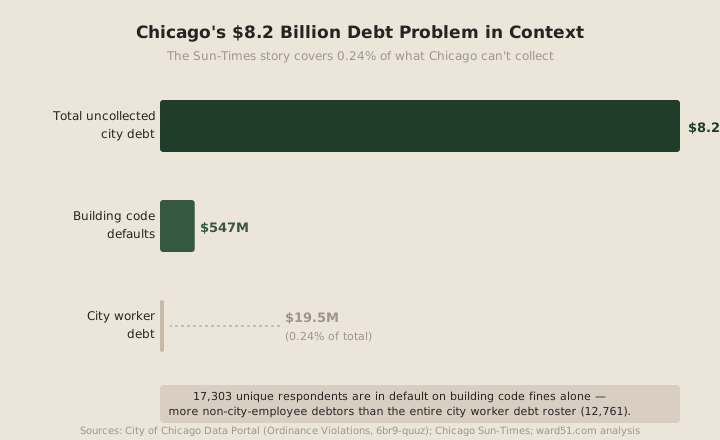
City worker debt is nearly invisible at the scale of Chicago's actual collection problem. Sources: City of Chicago Data Portal; Chicago Sun-Times; ward51.com analysis.
What the Open Data Actually Shows
The city worker debt figures came from a FOIA request to the Department of Finance — a closed administrative database that cross-references debt records with payroll rosters. That data isn't public. But the City of Chicago Data Portal hosts something that is: the Ordinance Violations dataset, updated as of today, covering every building code case the Department of Buildings has brought to administrative hearing.
It's 830,038 rows. We queried all of them.
Here's what the disposition breakdown looks like across the full dataset:
Default (respondent never showed or never paid): 115,175 cases — $547.2 million in fines imposed
Liable (found responsible): 295,773 cases — $253.6 million
Non-Suit (city dropped it): 256,144 cases — $4.5 million
Not Liable: 106,480 cases — $4.2 million
Continuance (pending): 31,532 cases — $2.3 million
The default pile — $547 million — is the number that matters. These are building code violations where the city issued a citation, scheduled a hearing, and the respondent either didn't show up or simply never paid. The city got a default judgment. And then, largely, nothing happened.
Those 115,175 default cases are spread across 17,303 unique respondents. That's more non-city-employee debtors in this one dataset — building code violations only, not counting the $2.3 billion in old parking tickets or the $723 million in unpaid water bills — than the entire city worker debt roster the Sun-Times identified (12,761 workers).
Where the Defaults Are Piling Up
The geography of building code defaults is not random. The ten wards with the highest all-time default fines are concentrated almost entirely on the South and West Sides:
Ward 6 (South Shore / Woodlawn): 8,093 cases, $40.0M
Ward 16 (Auburn Gresham): 7,584 cases, $39.7M
Ward 17 (Englewood): 6,283 cases, $32.0M
Ward 7 (South Chicago / South Shore): 5,680 cases, $31.4M
Ward 34 (East Garfield Park): 4,803 cases, $29.1M
Ward 20 (Chatham / Auburn Gresham): 5,968 cases, $28.6M
Ward 28 (Humboldt Park / Austin): 5,357 cases, $26.9M
Ward 9 (Calumet Heights / Roseland): 4,348 cases, $24.2M
Ward 8 (South Chicago): 5,016 cases, $24.0M
Ward 24 (West Garfield Park): 4,741 cases, $22.1M
This is the city's disinvestment corridor — predominantly Black, lower-income neighborhoods where property values are lower, housing stock is older, and landlords are more likely to be individual owners rather than institutional ones. The city is filing violations there. It's collecting the fines far less reliably. The enforcement machine runs; the collection machine stalls.
The Trend Isn't Improving
Default judgments in building code cases have been running at roughly 4,000–5,000 per year since 2022, after falling sharply during COVID-19 when hearings were disrupted. The dollar value of those annual defaults has held steady around $12–13 million per year since 2022 — and ticked up to $13.3 million in 2025. Since Mayor Johnson took office in May 2023, the city has accumulated approximately $34.5 million in new building code default judgments across nearly 12,000 cases.
The Sun-Times noted that Johnson added $1 billion to the overall uncollected debt total since taking office. The building code data confirms the pattern at a granular level: cases are being filed, hearings are being held, defaults are being entered, and the money is not coming in.
Why City Workers Are an Easy Target
Here is the one thing that actually distinguishes city employees from the 17,303 building code defaulters, the millions of parking ticket holders, and the water bill delinquents: they have a known employer with a direct payment mechanism. Wage garnishment is administratively straightforward when you know exactly where someone works and who cuts their check. The city doesn't need to find them, serve them, or chase them. It just needs to send a letter to the payroll department.
That's why the Sun-Times story lands — it's genuinely galling that even this most-collectible slice of the debt isn't being collected. But it also means the story is partly about the path of least resistance. The workers are visible, garnishable, and politically useful in a story about a mayor who has been reluctant to aggressively pursue debts. They are not, by any measure, the people primarily responsible for Chicago's $8.2 billion collection hole.
The city's actual debt problem is mostly owed by people who don't work for the city, who own or rent property in disinvested neighborhoods, who have unpaid parking tickets going back decades, and who the city has largely given up on collecting from — whether through political will, administrative capacity, or a judgment that the debt has aged past any realistic collection point.
The Real Question
If you want to be frustrated about Chicago's collection failure — and you should be — the city worker angle is fine as an entry point. The garnishment inaction is real. But the bigger question isn't why 12,761 CTA and CPS employees haven't been put on payment plans. It's why the city has a $547 million stack of building code default judgments that it apparently has no serious plan to collect, why that stack is growing by $13 million a year, and why it is concentrated almost entirely in the neighborhoods that have the least political power and the most deferred maintenance.
The Sun-Times found the most collectible 0.24% of the problem and wrote it as a character story. Fair enough — that's how watchdog journalism often works. But the data is public and the rest of the iceberg is right there. The workers aren't the deadbeats. The system is.
The Ordinance Violations dataset used in this analysis is maintained by the City of Chicago Department of Administrative Hearings and is available at data.cityofchicago.org. It was last updated April 4, 2026. All figures derived from ward51.com queries of that dataset. The $8.2B total uncollected city debt figure and $19.5M city employee debt figure are from Chicago Sun-Times reporting, November 2025 and April 2026 respectively.