
The Tipped Wage Dates Chicago Needs to Remember
How this was made
What Was Promised in 2023
On October 6, 2023, the Chicago City Council voted 36–10 to pass the One Fair Wage ordinance. The sponsor was Ald. Jessie Fuentes of the 26th Ward, then a freshman council member. The ordinance did one thing with a clear timeline: it committed Chicago to eliminating the subminimum wage for tipped workers by July 1, 2028, via five annual increases starting July 1, 2024.
At the time, roughly 100,000 tipped workers — servers, bartenders, bussers, runners — were earning a floor of $9.48 per hour. The ordinance said that floor would rise every July 1, reducing the employer "tip credit" by 8 percentage points per year, until tipped workers earned the same minimum as everyone else.
The schedule, as passed and signed into law:
July 1, 2024: Tipped wage credit reduced to 32% of minimum wage
July 1, 2025: Reduced to 24% — tipped floor reaches $12.62/hr
July 1, 2026: Reduced to 16% — tipped floor set to rise to approximately $13.97/hr
July 1, 2027: Reduced to 8%
July 1, 2028: Tip credit eliminated. Full parity with the $16.60 minimum wage.
Two of those five steps happened on schedule. Then the council voted to stop the clock.
What Happened Next
On March 18, 2026 — 29 months after the first scheduled raise took effect — 30 aldermen voted to freeze the tipped wage indefinitely at $12.62 per hour under Ordinance SO2025-0017549. No new schedule. No sunset date. Just: stop here.
Mayor Brandon Johnson vetoed it. He called it "tone deaf and shortsighted" and said the subminimum wage "has its vestiges tied to slavery." The council tried to override the veto on April 15. They needed 34 votes. They got 30. Four short.
That should have been the end of it. It wasn't.
Instead, Ald. Walter "Red" Burnett (27th Ward) brokered a new version — call it the compromise. On May 12, the Committee on Finance advanced it. On May 20, the full City Council voted 49–1 to pass it. The lone dissenter was Ald. Scott Waguespack (32nd Ward). For more on the March vote and its roll call, see our earlier piece Chicago Just Un-Did Its Best Wage Law. Here's Who Did It.
What the Compromise Actually Does
The May ordinance is not a permanent freeze. That distinction matters, and it's the entire basis on which aldermen who voted against the March freeze — including Fuentes herself — justified voting yes in May.
But "not permanent" covers a lot of ground. Here is the new schedule:
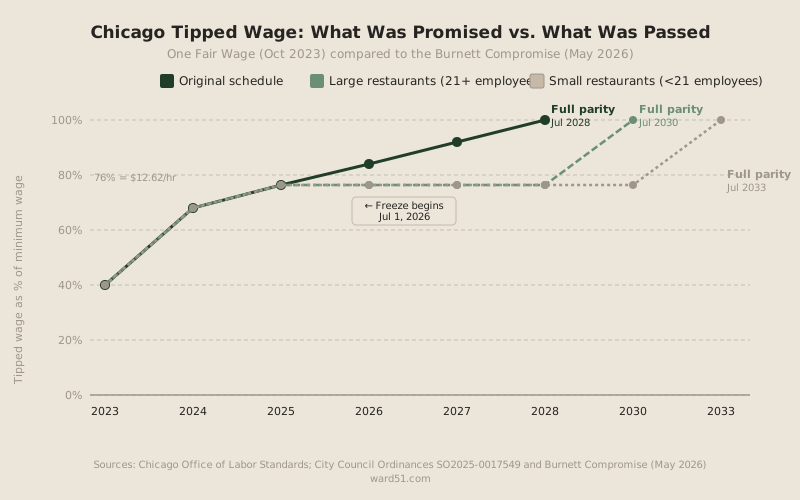
The original One Fair Wage schedule reached full parity in 2028. The Burnett compromise pushes that to 2030 for large restaurants and 2033 for small ones. Sources: Chicago Office of Labor Standards; City Council ordinances.
Large restaurants (21 or more employees):
July 1, 2026: No raise. Frozen at $12.62. (Was supposed to rise to ~$13.97.)
July 1, 2027: No raise. Still $12.62.
July 1, 2028: Raises resume. Annual increases begin.
July 1, 2030: Full parity with minimum wage. (Was supposed to be 2028.)
Small restaurants (fewer than 21 employees):
July 1, 2026 through July 1, 2029: No raise. Frozen at $12.62 for four years.
July 1, 2030: Raises resume. Gradual phase-out begins.
July 1, 2033: Full parity with minimum wage.
Workers at large restaurants just had their finish line moved from 2028 to 2030. Workers at small restaurants had it moved to 2033 — a full five years past what they were promised when One Fair Wage passed.
The Justification, in the Sponsor's Own Words
Ald. Fuentes, the person who introduced One Fair Wage in 2023 and shepherded it through the council, voted yes on May 20. She said she was "quite heartbroken" about the compromise. She voted for it anyway, because — in her framing — the phase-out is still intact. The principle survives. The delay is painful but temporary.
That is an honest account of her reasoning, and she deserves credit for saying it plainly rather than pretending she was enthusiastic. But it is also exactly the logic that makes permanent delays possible: you can always vote for a delay if the destination still exists somewhere in the future. The destination doesn't have to disappear for the journey to be effectively over.
The accountability question isn't whether Fuentes was wrong to vote yes. It's whether the council — all 49 of the aldermen who voted yes — will still be there when July 1, 2028 arrives for large restaurant workers, and July 1, 2030 for small ones. And whether anyone will be watching.
Write Down These Dates
Chicago has a well-documented habit of making firm commitments with specific deadlines and then renegotiating those deadlines when they become inconvenient. The parking meter deal was supposed to be a reliable revenue stream. The pension crisis was supposed to be managed by now. The 2026 budget was supposed to be balanced through a process that didn't end in the mayor and the council producing competing plans for the first time in city history.
"Temporary" is doing a lot of work in this ordinance. So is "eventually." So is the unspoken assumption that the political coalition that passed 49–1 today will still be intact when the restaurant industry comes back in 2027 asking for another extension — which, if the pattern holds, it will.
So here are the dates. Write them down.
July 1, 2028: Large restaurant tipped workers (21+ employees) are supposed to start receiving annual raises again after a two-year freeze.
July 1, 2030: Large restaurant tipped workers reach full minimum wage parity.
July 1, 2030: Small restaurant tipped workers (fewer than 21 employees) are supposed to start receiving raises after a four-year freeze.
July 1, 2033: Small restaurant tipped workers reach full minimum wage parity — ten years after the ordinance that promised it.
These are not projections. They are the dates written into the ordinance the Chicago City Council passed 49–1 on May 20, 2026. The aldermen who voted yes are on record committing to them. The workers who were promised a finish line in 2028 are now waiting on dates that run as far as 2033.
Whether this compromise was politically necessary, strategically wise, or the least-bad option available — those are real arguments, and reasonable people are making them. Ald. Fuentes made them honestly. Ald. Burnett made them honestly.
But Chicago's record on "temporary" delays to worker protections is not reassuring. The question isn't whether 49 aldermen meant what they said on May 20, 2026. It's whether what they said will still mean anything on July 1, 2028.
We'll check back.