
Who Pays for Chicago's Streets? The Car Subsidy Nobody Talks About
How this was made
Every time you pay your $148 Chicago vehicle sticker, it might feel like you're doing your part — covering the cost of the roads you drive on. You're not. Not even close. Chicago's 2025 budget reveals a stark gap between what car-oriented spending costs the city and what drivers and car-related taxes actually pay back.
This isn't a guilt trip. It's a math problem. And the numbers from the city's own budget ordinance are worth understanding if you care about how Chicago spends — and doesn't spend — its money.
What Chicago Spends on Car Infrastructure
Three city departments form the core of Chicago's car-related spending: the Chicago Department of Transportation (CDOT), the Department of Streets and Sanitation (DSS), and the Department of Fleet and Facility Management (DFFM).
Here's what the 2025 Budget Ordinance allocates to each:
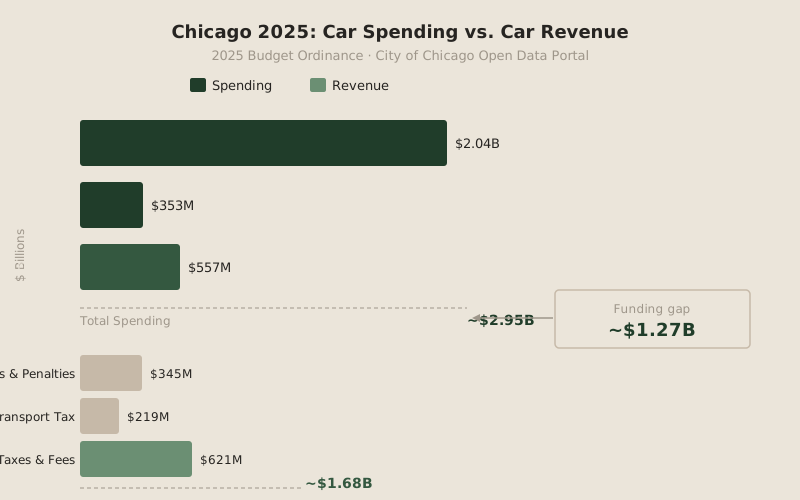
CDOT — $2.04 billion: Roads, bridges, traffic signals, bike lanes, pedestrian infrastructure, and capital project management. The vast majority of this — $1.73B — comes from federal and state grants earmarked for transportation.
Department of Streets and Sanitation — $352.9 million: Street cleaning, pothole crews, alley maintenance, and snow removal. These services exist almost entirely to support vehicle use of public space.
Department of Fleet and Facility Management — $557.4 million: Purchasing and maintaining the city's vehicle fleet — from garbage trucks to police cars. About $50 million of this comes from the Vehicle Tax and Motor Fuel Tax funds.
That's a combined $2.95 billion in city spending on departments that are substantially — if not primarily — oriented around cars and roads. Not all of DFFM supports cars exclusively (it also manages buildings), and CDOT funds some pedestrian and transit work. But the bulk of CDOT's $2B is road and bridge infrastructure.
The Capital Layer: Build Better Together
The operating budget is only part of the story. On top of those figures, Mayor Brandon Johnson launched the Build Better Together capital initiative in 2025, which includes resurfacing more than 150 miles of roadways and alleys, and the rehabilitation or reconstruction of more than a dozen bridges. This is funded through General Obligation bonds — borrowed money repaid by all Chicago taxpayers.
The region-wide picture is even larger. The Chicago Metropolitan Agency for Planning (CMAP) recently awarded nearly $894 million in federal funds for regional road and bridge projects covering 2025–2029. Chicago's own infrastructure plan borrowed $1.85 billion in 2022 for Phase 2 alone.
What Drivers Pay Back
Now for the revenue side. The 2025 Budget Ordinance Revenue dataset shows every car-related revenue stream the city budgets. Adding them up:
Parking Tax — $163.1M: A 22% tax on commercial parking transactions.
Vehicle Tax (stickers) — $126.2M: The annual city sticker fee.
State Motor Fuel Tax (city's share) — $116.8M: Illinois distributes a portion of gas tax revenues to municipalities.
Gas (utility/fuel taxes) — $98.5M: Chicago's local fuel tax.
Vehicle Fuel Tax — $57.5M: A separate per-gallon city surcharge.
Ground Transportation Tax — $218.6M: Covers rideshares, taxis, and limos — not traditional car owners, but still vehicle-related.
Fines, Forfeitures and Penalties — $345.2M: This catch-all bucket in the Corporate Fund includes parking tickets, red-light camera fines, and speed camera tickets. Speed cameras alone generated $90.9 million in 2024, and the 2023 total exceeded $102 million.
Natural Gas Use Tax — $27.9M, Municipal Parking — $16.4M, Motor Vehicle Lessor Tax — $6.2M, Auto Rental Tax — $4.8M, Sale of Impounded Autos — $2.2M
The total of direct car-related taxes and fees — vehicle stickers, parking taxes, fuel taxes — comes to approximately $621 million. Add in the ground transportation tax and that rises to $840 million. Include fines and penalties, and the grand total reaches roughly $1.68 billion.
That still falls well short of the $2.95 billion in car-related spending — a gap of at least $1.27 billion annually, plugged by property taxes, sales taxes, federal grants, and borrowed money.
Source: City of Chicago 2025 Budget Ordinance — Appropriations and Revenue datasets, Chicago Open Data Portal.
The Hidden Subsidy: Federal and State Grants
Here's the piece that rarely gets mentioned in budget debates: $1.73 billion of CDOT's $2.04 billion budget comes from federal and state grants. On the surface, that sounds like "free money." It isn't.
Federal transportation dollars come from the federal gas tax and general appropriations — meaning taxpayers everywhere are helping fund Chicago's roads. The Illinois motor fuel tax, distributed back to municipalities, adds another layer. Chicago gets a cut of fuel taxes paid statewide, not just locally.
So the question isn't just "do Chicago drivers pay for Chicago's roads?" It's "do drivers — anywhere — pay the full cost of road infrastructure?" The answer, consistently, is no. Roads are cross-subsidized by income taxes, property taxes, and borrowing at every level of government.
Fines as a Revenue Strategy
One revenue stream deserves special scrutiny: enforcement fines. Chicago's 2025 budget counts on $345 million in fines, forfeitures, and penalties. Speed cameras brought in over $102 million in 2023 and $90.9 million in 2024.
The BGA has documented how CDOT's appropriation jumped 37% from 2024 to 2025, from $1.48B to $2.04B. That increase was driven largely by capital project grants — but the operating budget still depends on fines to stay balanced.
This creates a perverse incentive: the city needs drivers to keep breaking traffic laws to fund the roads those same drivers use. The Fines and Fees Justice Center has flagged how this burden falls disproportionately on lower-income and South and West Side residents, who are more likely to live near speed cameras and less likely to pay fines promptly — triggering late fees that, in 2023, made up the majority of speed camera revenue.
What This Means for Chicago’s Wards
Chicago's Northwest Side sits in a part of the city where car ownership rates are higher than downtown, and where residents often depend on arterial roads that require ongoing maintenance. The aldermanic menu program allocates $1.5 million per ward per year for local infrastructure projects — a number that hasn't kept pace with the cost of road repairs.
The gap between what drivers pay and what road infrastructure costs isn't an argument to stop maintaining roads. It's an argument for honesty about who's subsidizing whom. Every time the city debates a CTA budget shortfall or a school funding gap, it's worth asking why we treat road spending as a baseline that gets funded first — before the question of who pays is even asked.
Car infrastructure in Chicago isn't self-funding. It never has been. The 2025 budget makes that clear in plain numbers.
What's Not Counted Here
This analysis uses only the city's operating budget and grant-funded capital. It doesn't include:
The opportunity cost of surface parking: land that generates no property tax but requires public maintenance of surrounding streets.
Traffic crash costs: CPD, Chicago Fire, and trauma center resources consumed by the 800,000+ crashes recorded in the city's traffic crash database since 2015.
Environmental and health costs: air quality impacts, stormwater runoff from impermeable pavement, and urban heat island effects from asphalt.
The privatized parking meter deal: The Chicago Parking Meters LLC concession, signed in 2008, has generated $1.97 billion for the private operator through 2024 — revenue that would otherwise have gone to the city.
When you add those factors in, the true public cost of car infrastructure is considerably larger than the budget line items alone suggest.
The 2025 budget is a public document. The Chicago Data Portal is free. If your alderperson tells you Chicago can't afford better transit, safer bike infrastructure, or more street trees — ask them to show you the numbers on what it's currently spending to make the city friendly to cars.