
606 Items, 5 Contested Votes: Inside the April 15 City Council Meeting
How this was made
The Chicago City Council met on April 15, 2026 with a 606-item agenda and all 50 members present. That's the headline number, and it already tells you something important: this body processes an extraordinary volume of business in a single sitting. What it doesn't tell you is how much of that volume is actual governance versus institutional theater dressed up as legislative activity.
Here's what the record shows: of 606 agenda items, exactly 5 produced a contested vote. That's 0.8%. The other 601 items passed unanimously — many of them without discussion, without debate, and in several cases without any apparent reason to occupy the time of 50 elected officials and their staffs.
That's not a sign of a council in rare harmony. It's a sign of a council that has built a remarkable tolerance for burying consequential decisions inside an avalanche of paperwork and ceremony.
Watch the full meeting on Vimeo →
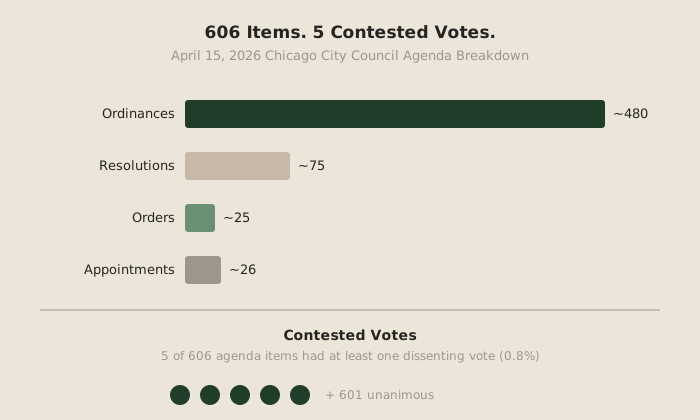
Data: Chicago City Council meeting record, April 15, 2026. Chart by ward51.com.
The Five Votes That Actually Mattered
The council's contested votes are where real disagreement lives — where alderpersons broke from the bloc and put a dissenting position on the public record. There were five such moments on April 15. Here's exactly what they were, who voted no, and why it matters.
1. Kenya Meritt for Commissioner of Cultural Affairs — 44 Yea, 6 Nay
This was the most contested vote of the day, and it wasn't close by council standards. Mayor Johnson's appointment of Kenya Meritt as Commissioner of Cultural Affairs and Special Events (A2026-0024073) passed 44–6, with nays from Ald. Matthew O'Shea, Ald. Silvana Tabares, Ald. Anthony Napolitano, Ald. Marty Quinn, Ald. Samantha Nugent, and Ald. Scott Waguespack.
Six nays on a mayoral appointment is a meaningful statement. The six dissenters are a mix of conservative Southwest Side and Northwest Side alderpersons alongside Waguespack, who represents the 32nd Ward on the Northwest Side and has built a reputation as an independent voice on fiscal and administrative matters. Whether the objection was substantive — qualifications, process, conflicts of interest — or political, the vote record alone doesn't say. The floor debate on the Vimeo recording is the place to look. What we know is that 12% of the council looked at this nominee and voted no.
2. Christian Diaz for Metra Community Rail Board — 48 Yea, 2 Nay
The appointment of Christian Diaz as director of the Community Rail Board (Metra) (A2026-0023418) passed 48–2, with nays from Ald. Samantha Nugent and Ald. Scott Waguespack — the same two who voted against the Meritt appointment. Nugent and Waguespack voting together on both appointments in the same meeting is a pattern worth noting. Whether this reflects a principled objection to the mayor's appointment process broadly, or specific concerns about these nominees, is a question the floor record would answer.
3. Water Revenue Bond Refinancing — 49 Yea, 1 Nay
The council approved a Seventeenth Supplemental Indenture securing Second Lien Water Revenue Bonds, Refunding Series 2026A (SO2026-0024095) — essentially a refinancing of existing city water system debt — 49–1. The sole nay: Ald. Raymond Lopez. Bond refinancing votes rarely generate dissent; when they do, it usually signals either a specific concern about the terms or a broader protest about the city's debt posture. Lopez casting the lone vote against a water revenue bond is the kind of data point that deserves a follow-up question to his office.
4. Chicago Torture Justice Memorial Funding — 49 Yea, 1 Nay
The council voted 49–1 to approve expenditure of Open Space Impact Fee funds for development of the Chicago Torture Justice Memorial at 5520 S. Dr. Martin Luther King Jr. Drive (O2026-0024100). The sole nay: Ald. Anthony Napolitano. The Torture Justice Memorial commemorates victims of police torture under former Commander Jon Burge. Napolitano casting the only nay on this particular item — while 49 colleagues voted yes — is a notable moment. The memorial has been years in the making. A single alderperson opposing it on the floor of the full council is a position that warrants explanation.
5. Taxicab Code Amendments — 49 Yea, 1 Nay
An amendment to Municipal Code Chapters 9-104 and 9-112 modifying taximeter rules, taxicab equipment requirements, inspections, license fees, and new service fare rates (SO2025-0019931) passed 49–1, with the lone nay from Ald. Brendan Reilly. Reilly represents the 42nd Ward, which covers the Loop, River North, and Streeterville — neighborhoods where cab and rideshare dynamics are acutely felt. His nay on fare rate and equipment rule changes could reflect constituent or industry concerns. Again: the floor debate is the primary source.
Also on the Docket: Substantive Items That Passed Unanimously
The contested votes get the attention, but several unanimous items from April 15 were substantively significant and worth flagging.
The council approved multi-family housing revenue bonds for the Lathrop Preservation Phase IC project (SO2026-0024082), covering multiple buildings along N. Hoyne Ave and N. Leavitt St — continued investment in one of the city's most ambitious public housing preservation efforts. It also approved HUB32 (SO2026-0024073), a multi-family development at 201 N. Kedzie Ave and 3209/3201 W. Lake St, funded through the city's multi-family program. Both passed 50–0.
A TIF district fund allocation for the Workforce Solutions Program (SO2026-0024038) also cleared unanimously — TIF money going toward workforce development is a use that tends to attract broad support, even from alderpersons skeptical of TIF spending generally.
And the council approved an expanded trespassing ordinance (SO2025-0017561), amending Municipal Code Section 8-4-050 to broaden the definition of trespassing and establish cumulative fines of $250 to $1,000 depending on the violation. This is the kind of municipal code change that can have real street-level consequences — and it passed without a single dissenting vote.
The Ceremonial Avalanche
Now for the part that doesn't make the press releases.
Scroll through the April 15 agenda and you'll find the council formally declared April 15 "Harold Washington Day" in Chicago. They recognized National Youth HIV/AIDS Awareness Day. They designated April as Arab American Heritage Month, Sikh Heritage Month, and Fraud Prevention Month. They declared April 13 "Borinqueneers Day." They declared April 30 "Women in Apprenticeship Day." They passed tributes to the late Rev. Jesse L. Jackson, the late Lori T. Healy, the late Rufus Chaney, the late James R. Iles, the late Lula Simmons, and the late Robert Andrew Pickens — all on the same day, all 50–0, all through the same legislative apparatus used to approve a water revenue bond refinancing.
These are not without value in the abstract. Honoring Harold Washington on a day bearing his name is appropriate. Recognizing community members who have passed matters. But let's be direct about what this looks like at scale: the Chicago City Council, which governs a city of 2.7 million people facing a structural budget deficit, chronic transit underfunding, and ongoing public safety challenges, spent collective aldermanic time on April 15 formally declaring awareness months and passing posthumous tributes — all routed through the same floor process as housing bonds and municipal code changes.
Every one of these resolutions required committee referral, floor scheduling, and a roll call vote from 50 alderpersons. Every one passed 50–0. The outcome was known before the vote was called. The process added nothing. The ceremonies themselves — the actual recognition, the speeches, the moments of tribute — could happen without a legislative vote. They don't need an ordinance. They need a microphone.
Attendance: All 50, On Paper
The official record lists all 50 alderpersons as present for the April 15 meeting. Full attendance is genuinely notable — council meetings routinely see absences, and the Q1 2026 report card documented patterns of chronic absenteeism among a handful of members.
But "present" in a 606-item meeting is a complicated concept. Being in the chamber when a vote is called on a posthumous tribute is not the same as engaged legislative participation. The contested vote count — 5 out of 606 — suggests that for the vast majority of the agenda, the operative mode was: show up, vote yes, move on.
That's not inherently a failure. Much of municipal government is routine administration that requires a formal vote but not a real debate. The question is whether the ratio of routine-to-substantive has drifted so far that the "legislative session" model is the right container for it. A consent calendar — where non-contested routine items are bundled and passed with a single vote — would free up floor time for the five items that actually needed it. The Chicago City Council does not use one in any meaningful way.
What a Streamlined Agenda Could Look Like
Other large city councils manage similar volumes with structural tools Chicago has resisted. New York City Council uses a robust committee pre-clearance process that keeps routine items off the floor entirely. Los Angeles uses consent calendars aggressively. Chicago's council, by contrast, runs every parking permit, every awareness month declaration, and every posthumous tribute through the same floor process as a tax ordinance or a bond refinancing.
The result is a meeting where 606 items require a quorum of 50 alderpersons and produce 5 moments of actual disagreement. The math should bother anyone who believes the council's time is a public resource worth protecting.
A consent calendar would not fix Chicago's governance problems. It would not close the budget gap, accelerate CTA capital investment, or resolve the structural tensions in the city's pension obligations. But it would make the council's genuine debates easier to find, easier to cover, and easier for residents to engage with. Right now, those five contested votes are buried inside 601 unanimous ones, in a meeting record that runs to hundreds of pages. That's not transparency. That's concealment by volume.
The Bottom Line
The April 15 Chicago City Council meeting produced five genuine moments of legislative disagreement. A mayor's cultural commissioner drew six nays. A Metra board appointment drew two. An alderperson stood alone against a water bond refinancing. Another stood alone against the Torture Justice Memorial. A taxicab code amendment got one dissent from the ward most directly affected.
Those five votes are the meeting. Everything else — 601 items — was unanimous. Some of it was substantive work that simply wasn't controversial. A lot of it was ceremonial throughput that had no business occupying the floor of a legislative body.
The council has the tools to fix this. A real consent calendar, a published list of contested items before each meeting, a searchable floor debate index — none of these require new legislation. They require the political will to make governance legible. So far, that will hasn't materialized. The April 15 meeting is 606 data points in favor of trying something different.
This piece was researched and drafted with AI assistance and edited by the ward51.com editorial team. Meeting data sourced from the Chicago City Council meeting record for April 15, 2026, via the ward51.com council data pipeline. Vote tallies reflect the official roll call record.